the coffee
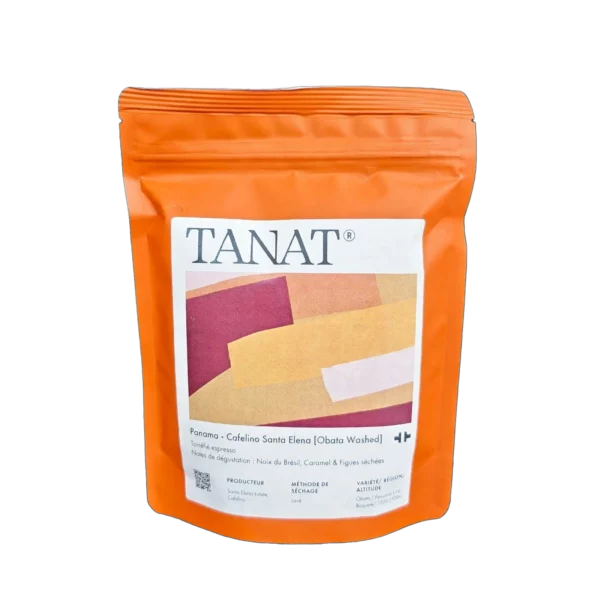
This single-origin Obata was grown at the Santa Elena estate, operated by Cafelino, in the hills above Boquete in Chiriquí, Panama. Harvest 2026.
In the cup: Brazil nuts, caramel and dried figs. A rich and indulgent espresso with a silky body and low acidity. The Brazil nuts bring sweetness, the caramel a creamy richness, and dried figs round out the profile for a balanced cup.
Obata is still relatively unknown in specialty coffee. It comes from a breeding program combining Timor Hybrid and Villa Sarchi, developed for strong disease resistance while keeping real aromatic potential. Grown at altitude, as at Santa Elena, it gives a smooth, structured and expressive cup.
the roaster
Tanat Coffee is a specialty coffee micro-roastery in Paris, France, active since 2016. Their focus is on roasting, with the aim of offering the best roast with the highest level of consistency.
Tanat sources directly at origin, working with farms, producers and cooperatives they often have known for years, and buys small, fully traceable lots. For this coffee, Tanat uses a medium roast intended for espresso.
the farm
The Santa Elena estate is operated by Cafelino, on the slopes of Piedra de Lino hill above Boquete, in Panama’s Chiriquí province. The 44 hectare estate lies between 1,200 and 1,530 metres above sea level, and about a fifth of it is primary rainforest.
Besides Obata, Cafelino grows Catuai, Caturra, Geisha and Pacamara, with a focus on sustainability, the preservation of biodiversity and exclusively hand-picked cherries.
the process
This coffee is washed.
After harvest, the pulp is removed from the cherries, followed by a controlled fermentation to break down the mucilage. The beans are then washed and slowly dried on raised African beds. The washed process brings out the finesse of the Obata variety.
our current recipe
Coming soon.